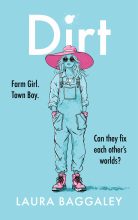
Dirt by Laura Baggaley
What led you into writing?
Ever since I first memorised Beatrix Potter as a small child, I knew that books were the best thing in the world. As soon as I knew that there were people who actually wrote books, people called writers, I wanted to be one!
How does a typical day look?
Depends on the day job! I teach acting, drama and writing at an adult education college (City Lit, a lovely institution in the centre of London) and writing has to fit in around all my courses. When I’m lucky enough to have a day at home, I’ll start writing as soon as the family has dispersed for school/college/work etc. and write for about four hours, with breaks to recharge my tea mug. More often though, I’m squeezing in an hour or two here and there. It also varies a lot according to different stages of the writing process. The first draft – where I’m splurging words onto the page – has a very different energy from the second draft, when there’s often significant reshaping to be done. Then you’ll find me staring at pieces of paper laid out all over the living room floor! In the detailed line-editing of later drafts, I sometimes have to get out of the house altogether and take my laptop to the local library for silent focus…
In what ways do your characters test your abilities?
I write fiction for children and young adults, so it’s always a challenge getting inside the head of my teenage characters, particularly when it comes to dialogue and the language they use. I have to be careful of using slang as it dates so quickly, but if I write too formally the characters don’t sound authentic. I’m lucky to have two teenagers myself, so I can test bits on them – and fortunately they’re very honest when I get it wrong!
What’s your setup?
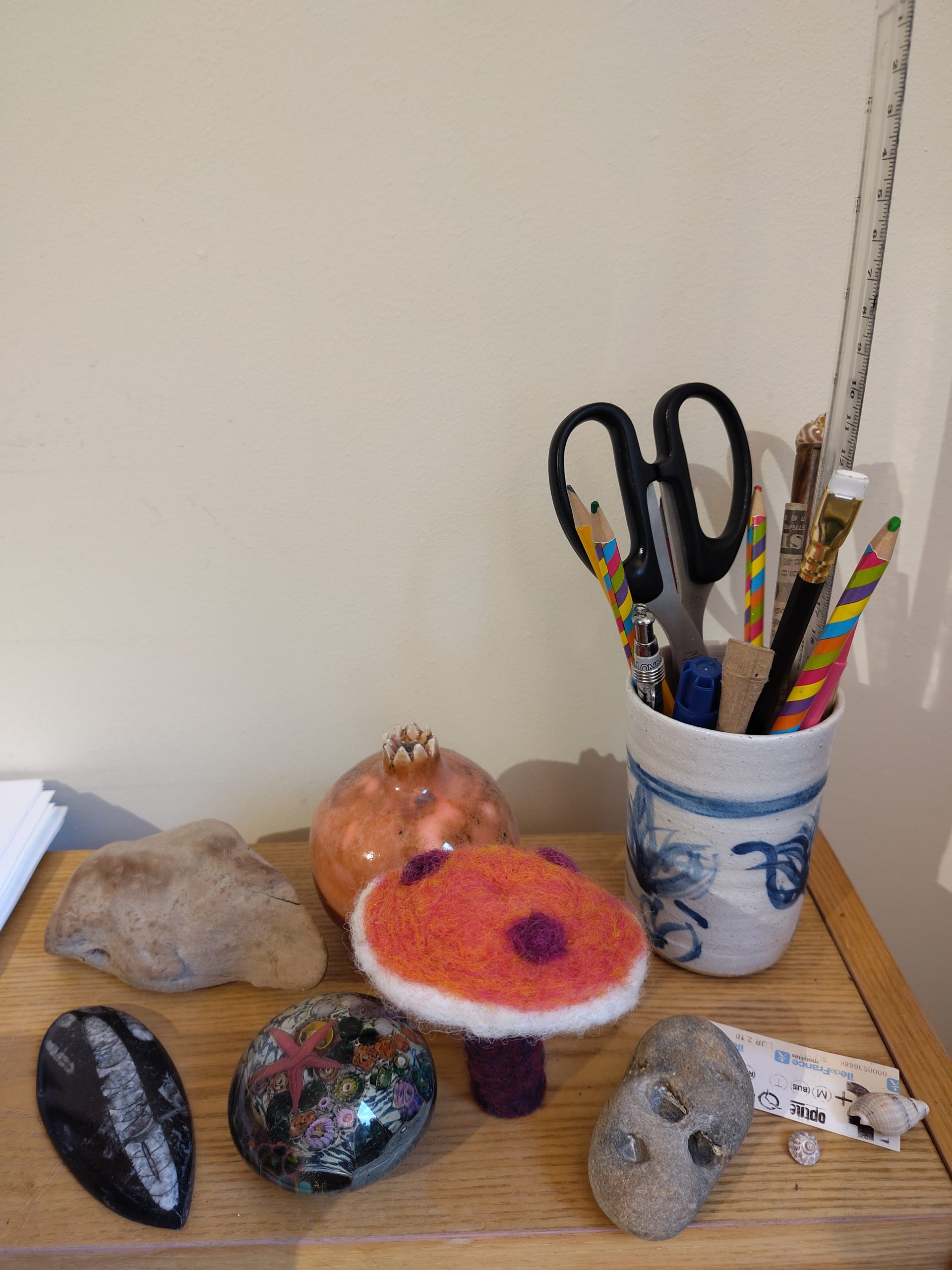
I have a little desk next to the window in a multi-purpose room in our busy family flat. I try to keep it from getting too cluttered, but I do have a collection of assorted objects on a shelf that are pleasing on the eye – including a piece of driftwood, a ceramic pomegranate, a stone with holes in it that looks like an alien skull, a felt mushroom, and a fossilised Orthoceras!
What lasting effects have your favourite authors had on your writing and style?
I think childhood reading has the strongest impact. The stories you read in those formative years get into your bones. I was obsessed with L. M. Montgomery and read the Anne of Green Gables and Emily of New Moon series endlessly. I can practically recite the Little House on the Prairie books. But I was also reading feminist fantasy books by the brilliant Tamora Pierce, and gritty young adult books like Rumble Fish by S. E. Hinton. I devoured huge quantities of historical fiction in my teens, and later developed a taste for thrillers, as well as reading all the classics for my English literature degree. So I’d say my influences are many and varied! The key thing I’ve taken from this, is that the style of writing has to suit the story. When I was starting out, my first two novels were aimed at adults, and I was approaching them in a very ‘literary’ way. I crafted many beautiful sentences but without much in the way of plot – they were really very boring to read and are still in the back of a drawer! When I started telling stories for younger readers, I naturally had to pare back my writing – and it became much stronger as a result. It was very exciting to explore quite a different style, and I think a wide range of reading experience contributes to developing that flexibility.
What do you do for inspiration?
Read fiction and go for walks. Read environmental reports and news articles, non-fiction books about politics and climate change; listen to podcasts and talk with other writers. I’m always intending to take myself on ‘artists dates’ and set aside time for art galleries and so on, but life has a habit of running ahead full steam so I rarely get the chance! But really, inspiration is everywhere.
What repeating themes do you find yourself pulling into your stories?
Death and environmental catastrophe! Which is quite funny, considering my latest book has been described as ‘warm’ and ‘gentle’ by multiple book bloggers! So these disaster-themes perhaps aren’t overtly present, but I think a lot about the climate and environmental crises, and inevitably these are woven through my stories.
I’m a big fan of the Green Stories Project, which runs free writing competitions encouraging writers to incorporate positive climate solutions into their stories. The aim is to smuggle these important ideas into mainstream fiction, to reach readers who wouldn’t necessarily choose to read eco-fiction. It’s become something I try to do in all my work – not to lecture or preach, but to normalise ways we can make the world a better place. And I’m very excited by the concept of ‘thrutopia’, a new genre which is neither utopian nor dystopian, but tells stories exploring ways ‘through’ to a better world. There’s exciting work going on in this field, and I’m part of a collective producing a Thrutopian magazine on Substack called Bending The Arc, publishing stories, poems, essays, novel extracts and more.
How do you wind down?
One of the tricky things about being a writer is that work and leisure overlap hugely, and writing at home makes it hard to set boundaries. Reading is both work and pleasure, and I definitely read to unwind. But for total brain rest it has to be television – preferably with the whole family, talking together over reality programmes like The Traitors or scaring ourselves with Alien Earth!
What sort of challenges do you regularly overcome while designing your world/setting?
World-building is a crucial stage in my process, as all my books so far have been set in near-future dystopian settings. I usually have one key idea as a starting point – e.g. ‘global food supply chains have broken down’ – and then I interrogate what that means, how that affects society on a big scale, and how it filters down to affect my individual character. So I start by writing down hundreds of questions, such as: ‘Is everyone hungry? What has the government done? Are there rations? Has crime gone up? What do people eat? What can grow in this climate?’ etc. I often have an immediate hunch about the answers to some of the questions, so then I’ll write those down as facts about the world. Other questions take a bit more pondering, and sometimes there’s research involved. Gradually I build up the picture. And of course, there are always gaps I haven’t noticed, so then I rely on my beta readers to give me feedback and help me spot things that need fixing or clarifying.
I also have practical strategies, such as drawing maps of everywhere important (including both local areas and building interiors). I always draft a timeline from the present day to the date the book starts, so I have a sense of how the world has changed between now and the beginning of the book, and a backstory chronology for each of the characters.
What are you reading at the moment?
I usually have several books on the go at once. Right now, that includes Doughnut Economics by Kate Raworth, a really important book about financial systems and how we need to change them, and Boudica: Dreaming the Eagle by Manda Scott, a big historical novel. I really admire Manda Scott – she hosts a brilliant podcast called Accidental Gods, and I studied on her thrutopian masterclass last year. And I’m re-reading Othello and A Merchant of Venice for the Shakespeare teaching I’m doing this term.
What’s the most useful advice you could give to an aspiring author?
Read. A lot.
Write. A lot.
Learn to edit. You’ll save time if you can afford to go to classes.
Stick at it.
Tell us about the book you’re promoting.
Dirt is an eco-romance aimed at 11-14 year-olds (and adult readers of YA novels!), published last year by indie publisher Habitat Press.
Food is scarce in Newbeck. Rations are meagre. Everyone grows what they can on government-allotted Squares of land, using seeds and soil bought from mysterious mega-business, the Green Cultivation Corporation.
One hot day, a strange girl rides into town wearing a sunhat as big as a bicycle wheel. She arrives alone, on a desert track from nowhere, full of questions no-one’s ever asked before.
Local boy Sam is fascinated by her. Why won’t she talk about her family and where she lives? Why is she so curious about his way of life? And why can’t he get her out of his head . . .
A dystopian eco-romance for young adults, Dirt shows that even on stony ground, hope can grow.
Readers and book bloggers have called it “a gem of a book” and said, “this may have been written with the young adult as a target reader but I think anyone would enjoy it”.
Here are extracts from a couple more reviews:
“Every so often, a book comes along that feels like a breath of fresh air – the kind of story that reminds us why we love curling up with a good read. Laura Baggaley’s Dirt was one of those surprises for me. Though set in a dystopian world where food is scarce and life feels controlled, the story has a warmth and tenderness woven through it that makes it hard to put down.” The Phantom Paragrapher
“A thoughtful and tender eco-romance that asks big questions while celebrating the small, hopeful sparks that make us human. Engaging, reflective, and surprisingly fun, it’s a YA story that will stay with you.” Momo Book Diary
👋 Hi! I run Author Interviews