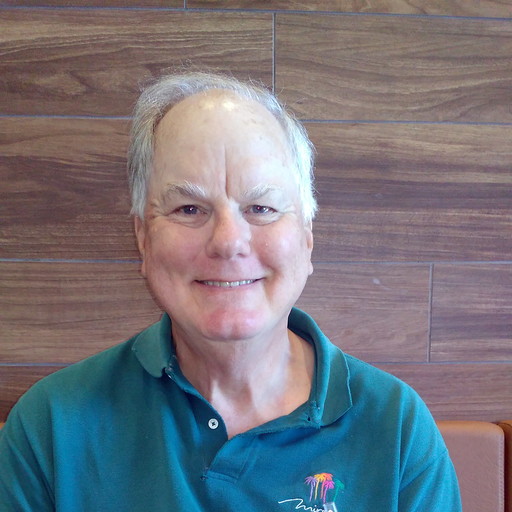
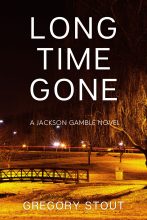
Long Time Gone by Gregory Stout
What led you into writing?
I wrote my first book, called Route of the Eagles (a history of passenger service on the Missouri Pacific Railroad) pretty much because I was interested in the subject and couldn’t buy a book about it that someone else had already written. That led to (eventually) 21 subsequent railroad histories, all traditionally published, and all fairly remunerative. I began writing young adult fiction as an outgrowth of the 12 years I spent teaching in a middle school (grades 6-8) after I left the private sector. Among other subjects, every year, I taught a section of reading, and I observed that it was harder to get boys to read than it was girls. So, I decided to write a novel I thought boys might want to read. That led to my first published novel, called Gideon’s Ghost, and the follow-up, Connor’s War. My first PI mystery, called Lost Little Girl, was a book I started nearly 40 years earlier, and, since I was able to get my YA fiction published, I updated my PI manuscript and sent it out to ten publishers of mysteries. I got six rejections and four positive responses, one of which offered me a three-book contract, and then a second. I have been with them ever since.
How does a typical day look?
I am no longer in the workforce (retired 15 years ago), so my day consists of getting up late, staying up late at night binging after 9:00 PM/2100 on Acorn and Brit Box streaming television (our favorites are “Vera”, “Foyle’s War” and “Brokenwood Mysteries”), lunching with friends, taking care of my lawn and yard and (during the summer months) swimming in our pool. I work on my writing for perhaps two hours every day, with mixed results. Some days, I can churn out a thousand words, other days a sentence or two. My wife and I go out to lunch every day, a habit we got into when we had an elderly parent living with us. It was our chance to have a bit of “alone time” while a caregiver looked in on my wife’s mother.
In what ways do your characters test your abilities?
So far, I have completed five Jackson Gamble PI mysteries (four currently in print, a fifth coming out in the fall) and a sixth that I am about halfway through. For me, the hardest thing is to make sure the characters stay fresh and not fall into predictable routines. So, for example, my Gamble character is a year older in each book, and in book five, I decided to let him have a minor heart attack (he has recovered nicely). He also has a woman friend, and in book six, they are contemplating moving in together. There is also the issue of suspension of disbelief. I review other works of fiction for a couple of U.S.-based publications, and when I am asked to review something in the thriller category, what I see is characters doing things and taking actions that would likely wind them up either being killed, or incarcerated (e.g., leaving a trail of dead bodies in their wake without law enforcement officials seeming to take notice). I want my characters to work their way through situations in believable ways, but also in a heroic way. At the same time, of course, my main characters need to remain in character, which is to say, if the reader likes the character, he or she wants that character to be familiar, like visiting an old friend, watching a favorite television program or dining at a favorite restaurant.
What’s your setup?
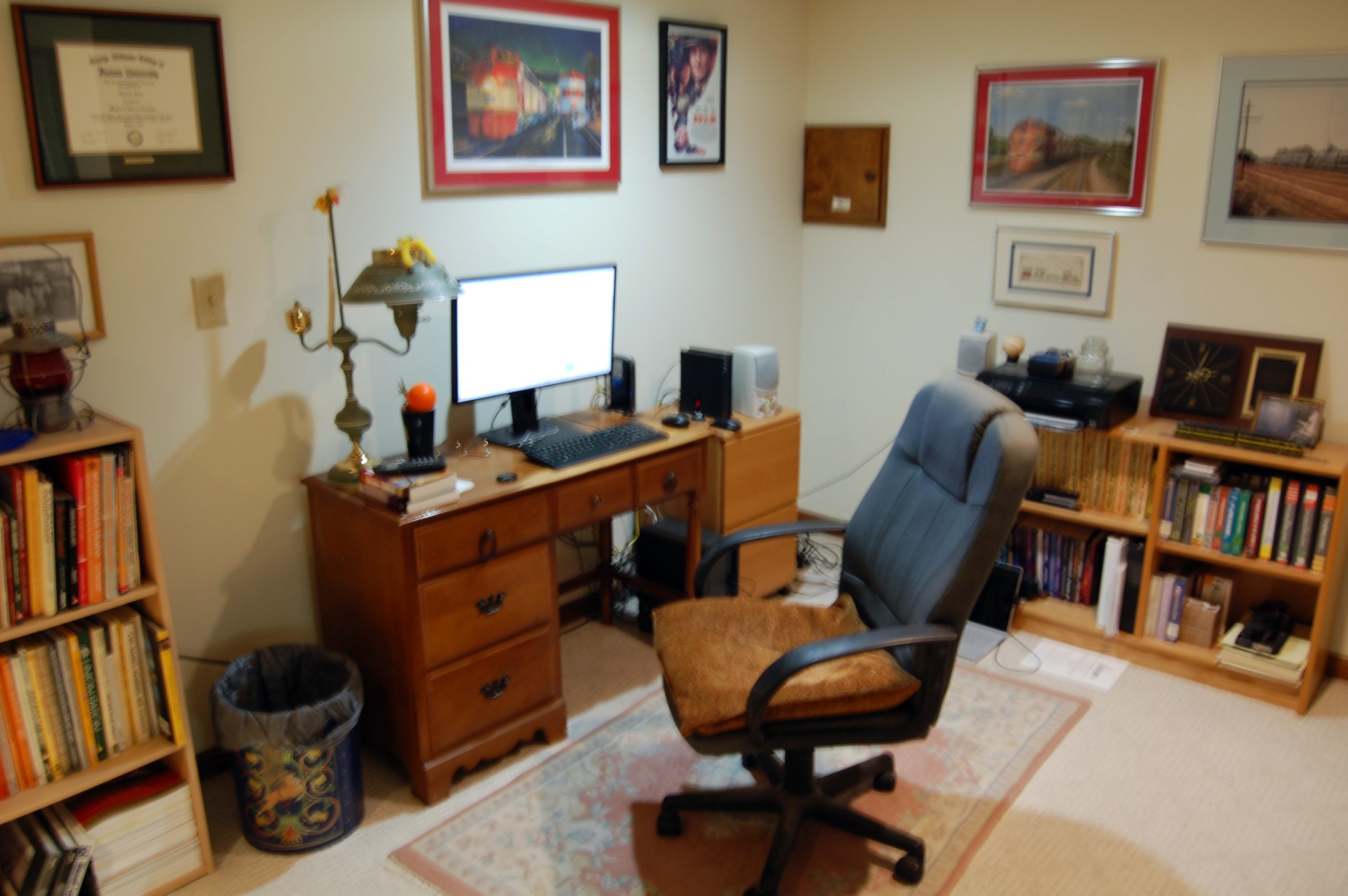
I have a spot in the basement (see photo, attached) of our home where it is completely quiet. I have a chair, a desk and a computer. Like some other people, I am easily distracted (as if a computer is not distraction enough), so no music, no pets, nothing that will cause me to lose my train of thought, or entice me to give myself a break from what I’m working on (which happens anyway)
What lasting effects have your favourite authors had on your writing and style?
I have several “favorites,” including Henning Mankell (the Wallander series); Dennis Lehane (especially the Kenzie and Gennaro series); Michael Connelly (Bosch); and a few of the “founding fathers” of detective fiction, including Dashiell Hammett, Raymond Chandler, Ross McDonald and Carl Hiaasen. And I suppose this begs the question, “But what about Agatha Christie? What about Conan Doyle?” And the answer is, years ago, I think I read everything both these two icons ever wrote. But, at the end of the day, good as they were, they were writing about contemporary British life as they were living it, so the authors that resonate with me are the ones who write in the present day. I am especially drawn to protagonists who resolve their conflict by taking risks, swimming against the current and using their heads, but not by killing everyone in sight on the off-chance that one of the bodies belongs to the culprit. That is simply not the way the world works. That is escapism (think: the Tom Cruise character in the Mission Impossible film series).
What do you do for inspiration?
Read, read, read, and try to watch television and film that reflects the same themes I am trying to capture in my books. There are only so many ways to commit a murder, and even fewer motives to do so (sex, money, jealousy, unbridled anger). However, there are an infinite number of ways to kick off a story. The other night, I was watching an installment of “Shetland” on our Brit Box channel, and the story started off with first, an arm, and then a severed head washing ashore on a beach in Shetland. So, the story will unfold around, first, who was the victim, and second, why was he killed? (And, by the way, as one who resides in a very temperate part of the U. S., Shetland appears on television as one of the bleakest spots in all of western Europe. I imagine one has to be particularly tough to live there.)
What repeating themes do you find yourself pulling into your stories?
In an earlier part of the form I completed for this interview, I was asked to select a genre, and the closest I could come from among the available choices was “hard-boiled.” This is a tag applied to (I think) mostly American private detective novels, where the hero shoots and fistfights his way to the solution of the mystery. Probably the best examples are the Phillip Marlowe novels, written by Raymond Chandler, and the Mike Hammer novels by Mickey Spillane. Jackson Gamble is not quite like that. He is not violent, except in defensive situations. he does not beat confessions out of suspects, and he doesn’t kill them because it’s quicker and easier than handing them over to the proper authorities. He has a heart, and he is, to the best of his abilities, principled. That said, a better choice of genre for me might be noir, in the sense that, unlike Father Brown or Miss Marple or Hercule Poirot, things do not always work out in the end. Sometimes, a good person gets hurt. Sometimes, a bad person gets away with it. And sometimes, despite his best efforts, the best Gamble can do is break even. The resolution of the story is not a one-hundred percent happy one; it’s just the best he can do given the milieu in which he operates.
How do you wind down?
Well, truth be told, I am never really done thinking about whatever book I’m working on. Part of the reason is that I have a “soft deadline,” which obliges me to furnish a finished manuscript to my editor every year. And, I suppose, for some authors, one book a year isn’t much of a challenge, but a year is almost exactly how long it take me to write and polish a book. The upside of this is that my manuscripts require very little developmental editing, and only minor redline (copy) editing. However, I am active in three separate writers guilds, two local, and one statewide. And spending time with other authors helps give me a sense that, however much trouble I am having at the moment, so are they. It is also inspiring to hear their stories of how they overcame various obstacles to completing their work. And, every now and then, I am visited by the muse who tells me how to resolve whatever difficulty I’m dealing with (usually this happens when I first wake up in the morning), and then, all is good, until next time.
What sort of challenges do you regularly overcome while designing your world/setting?
My PI mysteries are set in present-day Nashville, Tennessee. During the 1970s, my wife and I lived there, and when I started on the Jackson Gamble series, I chose Nashville for my setting, primarily because, unlike New York, Los Angeles, Boston and a handful of other major U. S. cities, Nashville hadn’t already been worked to death as a setting. Plus, there is the music industry located there, which yields an unending cast of interesting and sometimes offbeat characters. That said, the Nashville of the 1970s and the Nashville of 2025 are entirely different places. The population has doubled to nearly a million, downtown looks nothing like it did, it has become an expensive place to live, and, more than ever, it is today, a tourist destination. So. When I set a scene in my books, I have to resort to Google Earth Street View to be able to describe a place as it exists in the present day. I get that I am writing fiction, and not a travel guide, but I believe I owe it to my readers to get the details right. The story is fictional; the settings are the real thing.
What are you reading at the moment?
At the moment, three books: Farewell, Amethystine, by Walter Mosley; Desert Star, by Michael Connelly; and The Pennsylvania Railroad: The Long Decline, 1933-1968 by Albert Churella (this last one is 897 pages, including endnotes. I’ve been at it for quite a while).
What’s the most useful advice you could give to an aspiring author?
One of the most common things I hear from aspiring authors goes something like, “I think I have a book in me, but….” And the truth is, and I tell them this, everyone has a book in them, because everyone has had a lifetime of experiences: births and deaths, jobs gained and lost, illnesses overcome (or not), friends who have come and gone, or stayed, love lost and found, fictional worlds imagined, and so on. However, in the end, these stories will not write themselves. You have to just sit down and get started (I wrote my first novel traveling back and forth into Chicago on a commuter train). It is as difficult and as easy as that. Write something and see where it takes you. And whether it turns into the next Times best-seller, of just something to share with friends and family (or even put in a drawer for another day), nothing will happen until you write the story. I know a young woman who has written a very good fantasy novel, but who is afraid to submit it to a publisher because she dreads the rejections that are almost certain to follow. But that is the business all writers are in, and you just have to, as they say in sports (and this is my only sports cliche), you just have to play through the pain if you want to succeed.
Tell us about the book you’re promoting.
My newest release is called Long Time Gone, the fourth installment in the Jackson Gamble series. In this story, Gamble has two cases to resolve. One is rounding up a bail jumper named Tommy Mack. The other, and more involved investigation concerns the disappearance of a professor of classical languages who vanished four years earlier, ostensibly on his way to a faculty meeting at the small college where he teaches. The investigation starts out simply enough, but quickly becomes darker when the professor’s wife, the person who hired Gamble to find her husband, turns up dead in her own home from an overdose of insulin. So. Is her murder related to her husband’s disappearance? And did the husband disappear because of something he was involved with that might cause problems for other, more sinister figures? It takes a while, and it leads Gamble into a world of prostitution, drug dealing and organized crime before all the questions are answered.
👋 Hi! I run Author Interviews