

Chapter 1
Ingrid
April sun
bend your arms back
fireworks
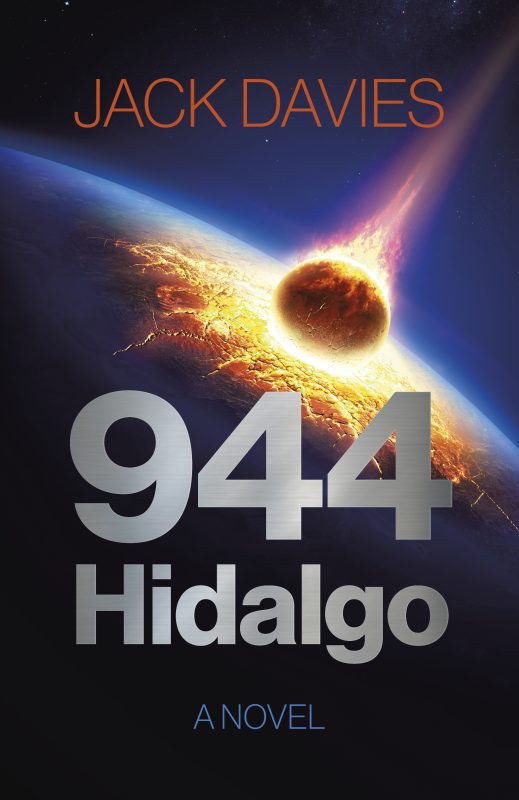
Saturn is less dense than water. It’s the only planet in the Solar System like that. Its Greek name was Cronus. It was on its day, Saturday, that Ingrid wrote. By Saturday, two weeks later, a piece of asteroid 944 Hidalgo, near Saturn’s ring, was heading towards Earth. Three days later it would kill everyone. Cronus was the son of Mother Earth, in Greek mythology, who castrated his father, Uranus, and threw his testicles in the sea. Aphrodite appeared from the white foam from Uranus’s testicles. Cronus ate all his children thinking they might depose him, except Zeus, who forced his father to throw up his brothers and sisters, and castrated him. Family can be tricky at the best of times.
Love is an even rockier road. I knew the mountains and lows of love’s fetid canals, the leaking refrigerator in the plum tree of blossom. All of that I understood, all that mattered was Ingrid’s letters, which I, a man with fire for hands, scooped up like Fabergé eggs rolled down Ladbroke Grove, and I had a hat as big as a bus to catch them.
The mining space station in orbit around Saturn revolved, so that even if she wanted to, it was impossible for Ingrid Bester to see her home of London, England as the timing was all off. This was Ingrid’s first trip in space. She wrote to me every day. We were in love.
She wrote to explain, “The viewing platform is on one side only, the side that faces away from Earth we see through our scopes. Sometimes I sit and peer out just to catch a glimpse, but as Europe comes into view, we turn another inch, and England is lost.”
She said all the other employees could see home, but not her. They were from different countries, different backgrounds, she was having a hard time fitting in. There was a gap in her understanding of who she was, without seeing where she came from. That gap was like the gap of not knowing her parents, or of falling over a waterfall and in mid-fall knowing that as the whirling pool below came up to meet her, she was alone, never moving forward.
She said she was hating space. Hating the repetition. But finding time to not hate. To be herself, despite herself. She said the mining corporation she worked for had identified a new near-earth asteroid, 944 Hidalgo, in the belt near Saturn and they were planning to launch a mining ship soon, on an intercept; to mine diamonds which had been detected was the purpose of the mission, of all space missions, wealth. Of course, she wasn’t involved in manning the ship, her job was purely admin, though she knew more than anyone really how these things worked, she had studied hard and gained her degrees and a PhD in astrophysics; it was just, things got in the way of her progression, mostly other people and their attitude.
Why did they feel the need to compete all the time? She never felt the need. But, anyway, she felt good to be part of the mission, in any capacity.
She wrote, “The time for knowing is past, what the future brings is shaped by the destiny we bring to our future. I wish I could have found love, but then, for what purpose? The purpose of me never depended on you. That purpose is more than the shame you talk about.”
Ingrid
She wrote, “You have such good qualities. Up here the weather is always the same. But I am changing. Maybe I am becoming what you want, docile and placid. That is not what I want. No one wants that.” She said that when the world comes around we are always pointed in a different direction.
She wrote later, “Thank you for your message, I am glad you are happy now, I hope you do not give up your thoughts, your actions. I feel that I have given too much. I had a dream about the shell from the Jokaca Sea. The material to coat inside, the green moss that grows only on the Kerselsha mountainside. The locksmith, Teraxa, you talked about. I constructed my own box. I have it here with me. I am not alone. I store my shame, word by word.”
She said life on the station, in the black night or in the light of the blinding awkward sun or hazy glow from Jupiter, had helped her to contain all her thoughts, and she was careful not to let them leak out like a stray tear. She wrote that she was exercising and meditating, that work was exciting now the launch date was close. She said she had set aside time to reflect on herself, as though she was standing on a mountainside and far below she could see herself, her actions, her thoughts, and not judge them. Words no longer hurt. Impatience was becoming less and less. She had time to allow other thoughts in. She said she could now confront herself like a stranger. As the mining lander launched she felt anger melting away.
She had let go of herself, like a large balloon pricked and deflating and happy to see it float heaven-wards.
She said she loved to write with a pen, even though she knew the ink became binary numbers as it hit the page-screen. She thought of days when she would type on a keypad, the touch of that was so different from the grip of the pen. Maybe the art of communication was shaped by the tools we use, like a tongue fitting in behind the teeth in a curl, pronouncing a word so very differently whether said with a smile or a grimace.
She wrote again to say the mining ship had landed on the asteroid. They had begun drilling. All was well. She would be home in another year.
She wrote, “The pen I write with now, that beams the numbers, splutters out every now and again, digital ink falls in a blot on the page-screen. Yesterday it formed a pool of blackness, with a beak and spindly legs that looked like a raven.”
She said how she longed to see an animal, to hear its voice. To touch a tree and feel earth under her feet. There was a longing for a home she had never experienced, as though her memories had been stolen and hidden in a cave, that the rocks themselves had absorbed her thoughts and were patiently waiting for her return to download and decipher them.
Two weeks later she wrote to say the mining ship had drilled deep into an asteroid, 944 Hidalgo. That it had extracted ore of platinum and cobalt, but then there had been an explosion which set off a chain reaction that ricocheted through the honeycomb interior. The ship lifted off just in time, with no loss of life. They were monitoring the asteroid. It had broken in half. The two pieces were drifting apart.
She wrote to me to say, “John, please listen. Update on the situation. I have smuggled this message to you. All communication has been banned. The asteroid, 944 Hidalgo 2, has found a new course, latest predictions are that it will enter Earth’s atmosphere in two hundred and fifty days. They estimate the main bulk of the debris will fall across Ireland and Britain. A sub-zero winter will come, the sun be blocked from view for five years. They say all life not underground will perish. Please, get underground, move to the hills in Scotland, it will be the safest place in Great Britain. There will be massive flooding, a deluge, a wasteland, it will affect the whole world. Millions will die. I will send more when I can.”
Later she wrote, “I hope you received my last message and you are on your way to Scotland. Please go. I told them in no uncertain terms, I could help them, that I had an idea, but they wouldn’t listen. They told me to go back to my room, take my meds, be a good girl. How can I be anything if I don’t speak up?”
“I stare out at the stars and wish I could dive deep into them. It feels like someone is watching out there, as though the stars were holes in the sky like peepholes through which someone or something peers down at me in my capsule room, padded with white like a mental health facility. I have just a tiny desk over my narrow bed, room to only sit up, one sliding drawer for artefacts, mementos from home. There is a fir cone we collected from the standing stones site in Portugal, remember, we had gone there to see forgotten megalithic stones, recumbent mostly, some caught in a tangle of wild brambles, others with trees that had grown around and over them. The fir cone is a strange fit in a world of white walls and metal, in this cylinder floating in space. I put it in my palm and looked into its hard, thick scales, its presence a reminder of home, of all that will be lost. The stones may well survive, Earth will spin around another day, but in three days people I know will be dead, and millions more. This thing will tear out our humanity, claw at the earth and all I think of our small things, those memories of sensations lost to the future. No more peace in those small pockets of my homeland where once I felt something, treasured a moment, laughed, cried, was connected to the landscape. No more all those precious things that make up the glue that holds lives together. When a place is fractured, how hard it is to bury the past when it must be buried with those memories lost in time.”