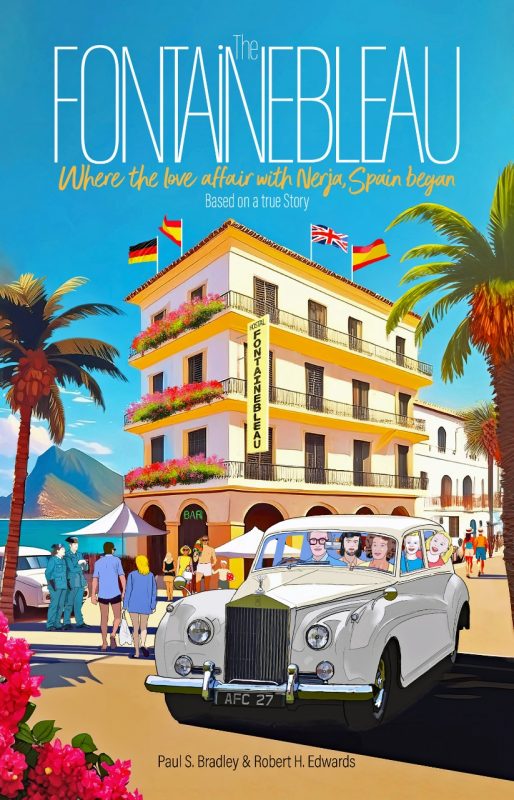
The Fontainebleau


The English Revolution
THE ENGLISH REVOLUTION
“Has Dad approved of your decoration project?” I asked, entering the hostel bar from the patio after my siesta. Jim stood on top of a rickety wooden ladder in the centre of the tiled floor between the dining tables. He held a grey plastic bucket in one hand and a paintbrush in the other. He stretched to his full height to reach the ceiling, which he splattered with what appeared to be thin globules of wallpaper paste. It went everywhere. His aggressive arm movements caused the ladder to lurch from side to side, yet he seemed oblivious to the danger.
“I’m bored to tears with bare white walls and ceilings everywhere, so I’m jazzing the bar up a bit. Dad said it was fine to stick my favourite racing car posters on the ceiling and mount some pictures on the wall. Can you give me a hand?”
“Only if you help me install the sound equipment after.”
“Fair enough, pass me, Brands Hatch?”
I gave him the picture of Brazilian Formula One driver Emerson Fittipaldi screeching around Druids Bend in a Lotus.
“Don’t take this wrong,” I said. But if we want to impress our guests, surely the theme should be flamenco artists, bullfighting posters, or Spanish cityscapes, not something they can see any day back home.”
“I don’t care what our guests make of them. These are for my enjoyment to help me cope with working in this place. I thought you liked Formula One?”
“I love it,” I said, choking back a giggle as the Brands Hatch poster peeled ever so slowly off the ceiling and wrapped itself around Jim’s head. “And I have no objections to your posters, but may I respectfully suggest they adhere more effectively if the paste is thicker.”
“It’s fine,” Jim snapped, untangling the poster and reapplying it to the ceiling. He held the paper until it stuck, then brushed out a few air bubbles. “Next.”
Eventually, the ceiling was half-covered with an overlapping collage of Silverstone, Thruxton, Cadwell Park, Mallory Park, Snetterton, and others. The floor, tables and bar stools were covered with wallpaper paste. Happily, the poster arrangement met with Jim’s approval. He returned the ladder to the storeroom and staggered back with an electric drill and several framed photos, mainly of him racing Mini Cooper S cars around Silverstone, which he’d started when he was seventeen. He’d shown some talent.
The pebble-dashed walls were rock-hard and tested Jim’s hole-boring dexterity. Four drill bits broke, and the electric motor smelled burned out by the time he’d finished. The pictures were crooked.
“I see you’ve inherited Dad’s skills around the house,” I said, mopping paste off the floor and furniture while Jim stood in the middle of the bar and admired his handiwork.
“They are up, aren’t they?” said Jim.
“Almost,” I said. “Except for those peeling away at the corners.”
Jim peered up and saw nothing of the sort.
“Damn.”
“Didn’t he do well?” I said, laughing. “Now, where can we mount the speakers and park the deck?”
Surprisingly, we laughed while transporting the gear from my room and discussing where everything should go. Within half an hour, the Goodbye Yellow Brick Road album by Elton John was playing.
My Mum stuck her head through the lobby door and joined us, dancing for a minute or two. We took turns to twirl her around. Dad joined us, just like in old times, back in our riverside home.
Dad checked his watch, turned down the music, and said, “It’s time to open for the evening.”
The mood turned tense as my parents exchanged worried glances.
Jim stomped off to shower.
I mopped up more paste. Jim returned in black trousers and a hotel polo shirt just in time to make the final tweaks to the tables for the evening session. The chef had prepped the food, and I had filled the ice buckets. At precisely seven p.m., the first guests of the evening came through the bar door, rubbing their hands, eager for their first drink. They were a well-dressed couple, he, tall in his forties, in a dark blue serge blazer and beige slacks, she a little shorter, slightly younger, in a loose blouse and skirt.
“A new face,” he said in a well-spoken voice, holding out his hand and gripping mine firmly. “Charles Bishton, my wife Jean. Let me guess; you must be Robert, right?”
“Are you hotel guests?” I asked.
“Good lord, no,” said Jean. “We’re your first regular locals. We run an estate agency called INFO on Calle Granada. We pop in every evening on our way home and often at lunchtime, so you’ll see a fair bit of us.”
“Can you mix cocktails?” said Charles as they slid onto barstools.
“Of course,” I said. “I worked in London’s Connaught Hotel. What would you care for?”
“Two dirty Martinis, please,” said Jean. “It’s been a heavy day.”
It took a while to track down a cocktail shaker and olives, but eventually, I found them. I then made a complete fool of myself with a pathetic attempt to add drama to the occasion. I threw the gin bottle into the air, aiming to catch it and then dispense a measure of spirit into the shaker with flair and style. I dropped the bottle. But kicked it back up before it smashed to pieces on the tiles, caught it, and poured as originally intended. Jim watched my every move, and I could sense his glee as the bottle hurtled to the floor. When my lucky footwork rescued the situation, he scowled, stomped off into the kitchen, and yelled at the chef. I continued mixing the cocktails, poured the drinks, added a stick of olives to each, and passed them over.
The Bishtons took a sip and nodded their appreciation. They chatted briefly about the real estate business in Nerja before Jean excused herself. She attempted to climb off the stool, but it was firmly stuck to her skirt.
“Is this your new strategy to keep clients drinking?” said Charles.
“I am so sorry,” I said, stifling a laugh. “We were decorating the ceiling earlier. Regretfully, my brother was a tad over-generous with the wallpaper paste. I thought I’d cleaned it all, but must have missed her stool.”
“Pass me a cloth and some hot water,” said Charles. He dabbed his wife’s backside with the damp cloth and gently peeled off the material from the stool inch by inch.
“Charles, darling,” said Jean after several minutes squirming with discomfort. “Could you speed it up? Only I need to…”
“Hold on, dear. Nearly there,” said Charles. However, the skirt refused to be separated from the stool as Jean wriggled furiously.
“Wait,” shouted Jean. She turned back, grabbed the material, and yanked it hard.
The bottom half of the skirt remained glued to the stool, but such was her desperation; it ripped below her petite derriere, and she was able to grab her bag and sprint to the ladies’, her damp pink underwear exposed. When she’d disappeared, we howled with laughter. She returned, suitably relieved, and bashfully twirled to reveal that a safety pin had provided an acceptable level of decorum.
Charles, meanwhile, had separated the rest of her skirt from the stool and presented it to her with much aplomb.
She gracefully accepted and stuffed it in her handbag after a curtsey.
“How gracious,” said another new voice as a man of medium build and height joined them. He was in his fifties and spoke with a northern English accent. “I have no objections to unusual fashion statements, but may I inquire why half your skirt is missing?”
I stood waiting, eyebrows raised.
“Robert, this is David Rowcroft,” said Charles.
We shook hands, and I put on another album—the Carpenters singles.
“Along with astute fashion awareness, David is also known as Mr Ten Per cent,” said Jean, pausing to hum. We’ve Only Just Begun.
“He is an accomplished Spanish speaker,” said Charles. “Keen to introduce English-speaking newcomers needing help to his pool of friendly and capable Spaniards. Surprisingly, they are efficient and reasonably priced, so we use them regularly. His wife, Kay, teaches English to young Spanish children.”
“She’ll be along shortly,” said David.
“Don’t let the grey complexion, extended belly, and mild perspiration concern you,” said Charles. “Like us, he likes his alcohol and, until around the fifth drink, continues to spout more or less intelligible sense.”
“Now you’ve mentioned the elephant in the room,” said David, chuckling, “I’m not here to discuss my shortcomings, admire the grotty new Formula One ceiling paper, or astound you with my repertoire of terrible jokes. As Charles so eloquently put it, I like my drink. Vodka and orange are my poison. This is the only time I’ll mention it. In the future, Robert, pour whenever you see me, but keep the ice to a minimum. It plays hell with my liver. Ah, there you are, darling. Robert, this is my wife, Kay. Robert is fresh off the boat and the latest member of the esteemed Edwards family to join us in our little patch of paradise. He’s brought a stash of music, which I hope will brighten our otherwise tedious life in the sun.”
I shook hands with the slender, well-spoken lady with an elfin face. She was smartly dressed in an elegant royal blue sleeveless dress, short blond hair, and sunglasses.
“We are easy clients,” said David. “We both drink the same, except Kay prefers lots of ice. Her liver is more robust than mine.”
“I look forward to chatting later,” I said as the next customer pressed me for service.
The bar filled. Jim circulated menus and took food orders. I served three customers at once with pints of San Miguel when Mr Hancock, dressed in a grey suit, barged his way to the front of the crowd. “I still don’t have my case. Do you have any news?”
“As you can see, Mr Hancock,” I shouted as beer froth spilt over the rim of a glass into the drip tray. “We’re a tad busy. Anyway, the airport offices are closed, so we won’t be able to call them until morning. Did you give your laundry to my mother?”
“Yes, but I still don’t have my suitcase. This is most unsatisfactory,” continued Hancock at full volume.
He kept blathering on and on about his luggage at full volume, completely unaware that the music had finished and the whole bar had fallen silent.
Deadly silent.
I served pints to another guest, noted his room number, and turned back to a snorting Hancock.
To my horror, two tall, burly, uniformed officers from the Guardia Civil were standing directly behind Hancock, towering over him and glaring at me. Their ungainly tricorn hats, tilted slightly forward, cast a sinister shadow over the top half of their faces. To their left was a mean-faced man in his late fifties with a scarred lip. A faded brown leather patch covered his left eye. He wore blue jeans and a black leather jacket with a prominent bulge under his left arm. All three were intimidating, exactly as Franco intended. Every customer watched them warily; you could hear a pin drop.
“As I was saying, I don’t have my suitcase,” shouted Hancock, failing to notice I had turned white and was looking over his shoulder. “Mr Edwards, I’m not accustomed to being ignored.”
I stared at Hancock and indicated with head and eye movements that he should turn around. “Is there something wrong with your eyes?” said Hancock. I repeated my eye movements, more exaggerated this time. Finally, something twigged. Hancock shook his head, turned, and glared at the officers. “At last,” he said without batting an eyelid. “Someone in authority. Have you brought my suitcase?”
The officers were astonished.
The man with the eyepatch shoved his colleagues aside and stood glowering at Hancock as if he were a piece of something he had trodden in. Spittle dripped down his chin. He lowered his forehead until it was almost touching Hancock’s. Hancock appeared unfazed by the invasion of his personal space or the man’s foul breath and flying saliva.
Jim bulldozed his way through the crowd and stood by the officers. “C… c… can I help you?” he said in English. He appeared terrified.
A rapid exchange of Spanish ensued between the officers. Eyepatch handed me a piece of paper. I glanced at it and couldn’t understand a word.
Wondering why nobody had collected the plated meals for service, La Rubia joined us, grabbed the paper from me, and scanned it.
“What do they want?” I asked.
“The hotel, she must close immediately,” said La Rubia. “You ‘ave no hopening license. All guests pack their cases; leave now.”
“Is this a joke?” I asked. “And what’s an opening license?”
La Rubia consulted with the officers. With each second, he grew more nervous.
The elder of the two officers spoke to the man with the eye patch, who nodded without speaking. He removed a notebook from his jacket and opened it while glaring at me. “Nombre, name?” he said, pulling a pencil from behind his ear and licking the point.
“¿Por qué, why?” I said, digging deep into the shallows of my vocabulary.
The man with the eyepatch glared at me with pure contempt and opened his jacket to reveal a pistol in a holster under his arm.
“Robert Edwards,” I blurted out.
“Que?” said the man.
“Robert,” I paused, waiting for the man to write it down, but he did nothing but stand and stare at me, pencil poised.
“Edwards,” I said. “Rob…ert, Ed…wards.”
Eyepatch made to write it down, but seemed to have no idea how to spell the foreign name. He scribbled something, turned back to the older officer, and nodded. The officer faced me and barked out his instructions.
“What do they want me to do?” I said.
“You m… m… make announcement,” said La Rubia, his knees shaking. “P… p… people must go now. If not, they go prison, you too.”
I looked pleadingly at my elder brother.
Jim shrugged and turned away.
“Ladies and Gentlemen,” I said. “These officers have ordered us to close the premises immediately. Hotel guests should pack their cases and leave; bar customers should depart now. Sorry, but I have no idea why this has happened or how to prevent this.”
“But I do,” said Hancock, hopping on tiptoe and shouting at his countrymen through the gap between the officers’ shoulders. “Ladies and Gentlemen, my suitcase has still not arrived. It is an extremely precious possession, and I refuse to go anywhere until the Spanish authorities responsible for its loss deliver it here. There is no way a tiny town like Nerger has enough cells to accommodate all of us, so I suggest we sit down and don’t budge until these gentlemen rescind their orders.”
There was a general murmuring.
Hancock sat down right in front of the eyepatch and glared at him.
“We’re with Hancock,” said a gruff, well-spoken Londoner, who, along with his family, joined Hancock on the floor and folded their arms.
One by one, every person except the staff followed suit, sitting with folded arms and glaring relentlessly at the officers standing in their midst.
The furious younger officer drew his pistol and slowly and deliberately pointed it at Hancock’s head and cocked the trigger.
I assumed I was about to witness my first death, yet Hancock remained unfazed by the possibility of instant departure and continued glaring despite the barrel touching his forehead. He was British and, therefore, superior. The idea of a foreign police officer shooting him was preposterous.
For several minutes, nobody moved.
The Brits continued to glare at the officers.
All three aimed their weapons at the seated assembly.
A classic stand-off.
The police seemed perplexed when no one lowered their gaze. Under such intense scrutiny from such an obdurate crowd, they shuffled their feet and, for the first time, began to appear unsure of themselves.
Hancock scrambled to his feet and slowly but confidently approached the younger officer. When near enough, he lifted his hand and, with a pointed index finger, pushed the gun barrel aside, staring directly into the officer’s face.
I was terrified, aware of their formidable reputation, but as I peered around surreptitiously, my fellow citizens continued their protest confidently.
Ignorance must be bliss, I thought.
“Can someone point out as delicately as possible to our dear friends,” said Hancock, now peering up the nose of the younger officer. He spoke loudly and clearly as if he were addressing a council meeting. “There are over four hundred thousand British tourists in Spain, with a further three million to follow throughout the summer. If you insist that we leave now, this story will be published in every newspaper worldwide and broadcast on every TV station. It will cause an international incident. Nobody will visit Spain for decades, and the income of every hotel and tax revenue will plummet. How do they think Generalissimo Franco will react? Do they think he will sit by and ignore your shortsightedness? No, he is desperate for the foreign currency. I think it is more than likely that you will lose your jobs and pensions and may even face imprisonment. Do you want to be held personally responsible for this, or would you kindly reconsider your orders and let the lawyers sort the paperwork out in the morning?”
“Did you understand, La Rubia?” I asked. La Rubia nodded. “Translate every word, and don’t hold back.”
La Rubia stepped nervously toward the officers and blurted out the translation. For a moment, there was no reaction.
The one with the eyepatch exploded in a rage and waved his pistol erratically at the seated assembly. “How dare they speak to us like this?” he shouted, spittle flying everywhere.
The older officer calmly placed his hand over the pistol. “There might be a mistake here,” he said. “I suggest we allow our superiors to sort this out tomorrow.”
The older officer, wearing an eyepatch, had a heated but whispered discussion. Franco’s name was often mentioned. Gradually, the man with the eyepatch calmed down and nodded in reluctant agreement.
“Mañana,” said Eyepatch.
“Mañana?” said The Younger, holstering his weapon.
“Mañana,” said The Elder and led the way out.
Eyepatch put away his pistol, followed them, paused at the exit, and glared at everyone.
His exaggerated sneer of contempt at the seated assembly left everyone in no doubt that this was not over.
“Bastardos Ingleses,” he shouted and tried to spit on the floor, but due to his constant dribble, he lacked enough spit to form enough ammunition. What little he did manage to collect dribbled down his jacket onto his blue jeans. “Harrumph,” he grunted, wiped his mouth on his sleeve, and headed out. I watched him as he entered the lobby. He stumbled against the wall and out into the street.
Glances of relief were exchanged among the seated gathering. They waited until Eyepatch had disappeared and scrambled to their feet.
“Three cheers for Hancock,” said someone.
After the applause faded, I turned to La Rubia. “What happens now?”
“This nightmare. You disobey the biggest shits in the Franco regime. When people disappear, them three involved.”
“Who are they?” I asked.
“Elder, Guardia Filipe Álvarez, other, younger brother, Javier. Everyone call him ‘El Cuchillo.’ knife. He scalp victims before burying alive. Man with eyepatch is Diego Cienfuegos, jefe secret police. A dangerous hombre. Notebook full of names of people he no like. When they disposed, he cross them out.”
“What’s with the eyepatch?” I said.
“He injured during civil war,” said La Rubia. “He lost eye, took shrapnel in mouth and has balance problem but he still mean as shit.”
“And now my name is in his book,” I said, pouring a large Cuba Libre and gulping it down.
“Yes,” said La Rubia. “You need watch out.”